


When architects and designers evaluate wall finishes, the ceiling often gets approached as a separate category. Standard spec logic tends to push overhead surfaces toward millwork, tile, or paint. We built SanFoot to go wherever a flat or curved surface needs the warmth and continuity of natural wood veneer, and ceilings are part of that.
The properties that make SanFoot practical on a wall also make it viable overhead. Flexibility, light weight, and a prefinished surface are features of the material itself, not limitations tied to a particular orientation.
Flexible and Light by Design
SanFoot is flexible enough for radius installation and light enough for ceiling applications. Those two qualities go together. The same thin, prefinished construction that allows SanFoot to bend around a column is what makes it practical to apply overhead using traditional wallcovering tools and paste.
Installation follows the same process used on walls. Commercial wallcovering installers work with our approved primers, wallcovering adhesive, and standard tools. The substrate must be clean, smooth, and dry before priming and application, and that requirement holds at the ceiling just as it does at the wall.
Substrates and Surface Preparation
Projects that have used SanFoot on ceilings have worked with a range of substrates: GRG board, MDF, gypsum board, acoustical panels, and metal panels. Surface preparation requirements are consistent across all of them. Drywall needs a Level 5 finish, the correct primer must be applied, and only our approved adhesives should be used. Substituting products voids the manufacturer warranty.
Acoustical panels are a common substrate in performing arts and education spaces, where the ceiling has to carry a finished material and manage sound at the same time. SanFoot bonds to microperforated acoustical panels without affecting their acoustic function.
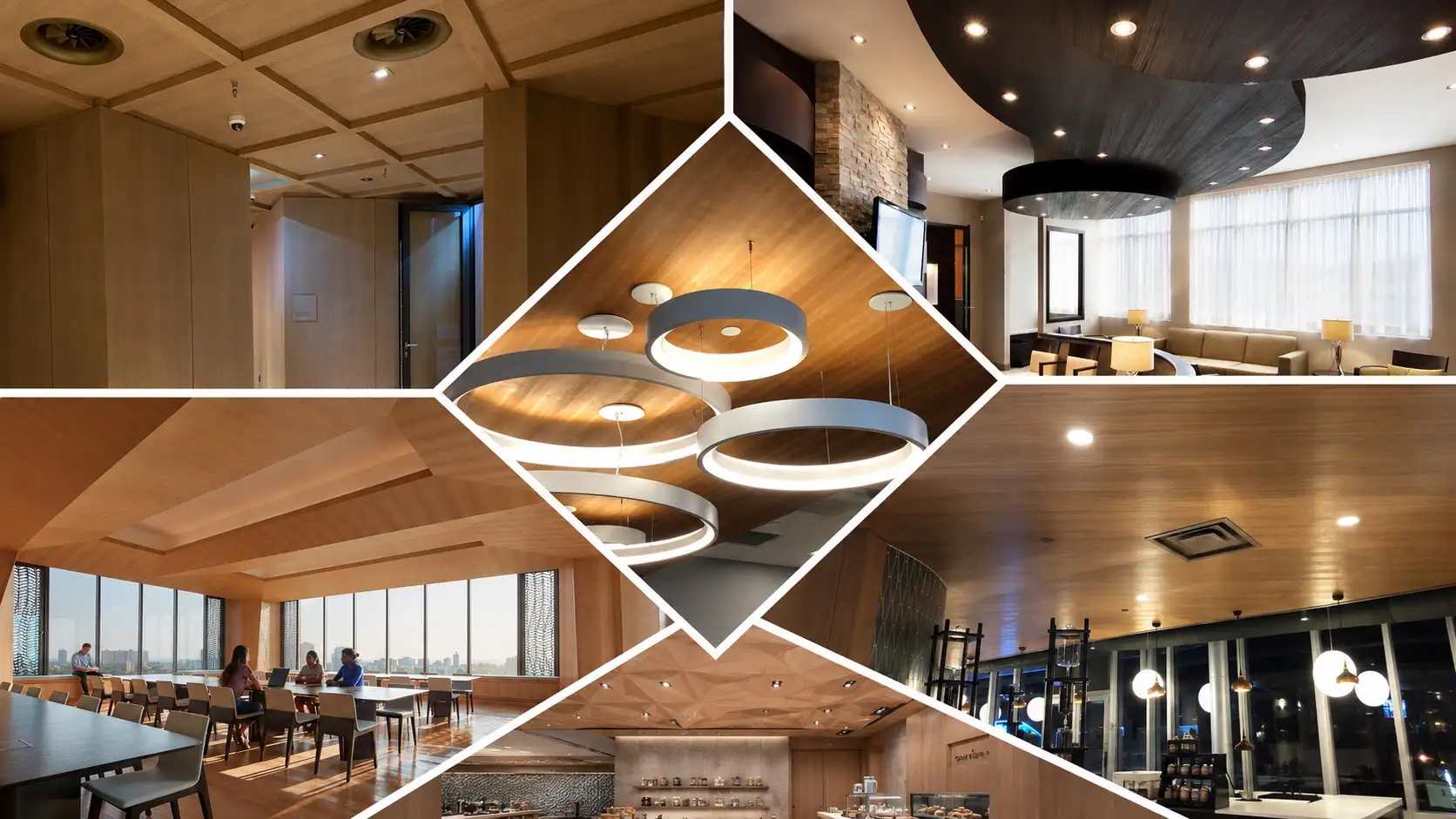
From the Project Record
The Tianjin Juilliard School, completed in 2020, used over 150,000 square feet of SanFoot Eucalyptus Quarter Cut Random Match, stained, across walls, ceilings, and architectural millwork throughout a performing arts and music education hall in China.
At the Starbucks Reserve Roastery in Tokyo, SanFoot Beech Quarter Cut Slip Match was applied to microperforated acoustical panels and metal wall columns across four floors. The fourth floor features an origami ceiling design with SanFoot carrying the pattern overhead, 48,000 square feet in total.
Monroe Community College Theater in Rochester, New York, specified SanFoot Cherry Quarter Cut and Walnut Flat Cut on both walls and acoustic ceiling reflectors. The project drew on SanFoot’s ability to sequence and invisibly seam sheets to achieve panel dimensions that would have been difficult to reach with other materials.
Before Writing It Into the Spec
The space must be environmentally controlled before and during installation: 45 to 85 degrees Fahrenheit, with relative humidity at or below 50 percent. Sheets should acclimate for 24 to 48 hours before installation begins.
For ceiling applications that involve acoustical panels or specialty substrates, contact Jacaranda for guidance on the correct adhesive and primer combination before the spec is finalized.